
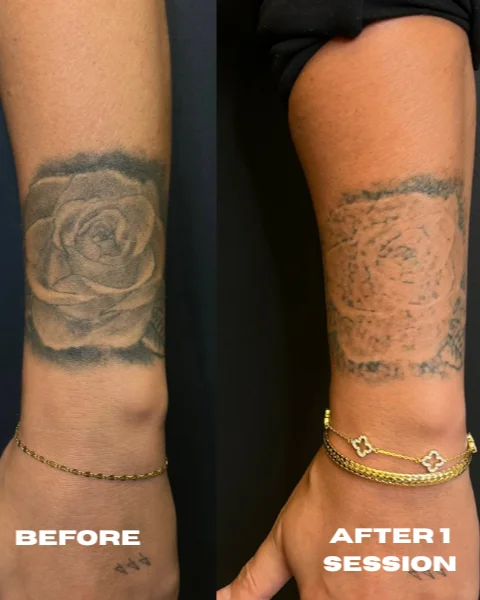
Changing your mind about a tattoo does not have to mean deciding immediately on complete removal. Some people want the ink lightened enough for a new design; others want as much of it removed as possible. Both start with an assessment, but the desired stopping point may be different.
Understanding that goal helps you have a more useful conversation about time, cost and expectations. Here is how removal works in broad terms, what an estimate can tell you and what to bring if you are thinking about a cover-up.
THE SHORT VERSION
Tell your provider whether you want fading for a cover-up or removal, and ask what is realistic for your tattoo.
Define what you want next
You may love the idea of a new tattoo but need room for a different design. Or you may want the existing ink gone. Explain that goal at your consultation. If you are planning a cover-up, bring the proposed design or questions from your tattoo artist so the conversations can inform each other.
Be careful with session promises
The AAD explains that tattoo removal takes multiple treatments and that complete removal is not always possible. Cosmetic inks can respond differently, including darkening. Ask for an individual assessment and discuss the potential risks, rather than assuming a timeline from someone else’s tattoo applies to yours.
Understand what an estimate means
Mrakki’s calculator gives an estimated range for one session based on the measurements you enter. It is not a total removal quote. Ask how your tattoo is measured, what the final session price includes and when the plan will be reassessed. A useful budget distinguishes one appointment from the whole course.
Let healing set the pace
Ask your provider how recovery affects scheduling and when the area can be considered for further work. Do not arrange a new tattoo over the area based only on an online timeline. Keep your treatment records and progress photos so you can discuss changes at each appointment.
What laser removal actually does
The FDA explains that laser energy breaks tattoo pigment into smaller particles, which the body clears over time. Different colors may need different laser wavelengths, and complete removal is not guaranteed. That is one reason a tattoo cannot be priced or scheduled from its size alone.
Size helps describe the area, but the ink and previous work also matter. Tell the provider about cover-ups, touch-ups and any past removal attempts. A photograph is useful for an initial conversation, but it cannot replace examining the skin.
A worked example of Mrakki’s estimator
The current estimator multiplies length by width in inches and uses $25–$40 per square inch, with a $100 minimum for a session. For a tattoo measuring 2 by 3 inches, that is 6 square inches: an estimated $150–$240 for one session. A 1-by-1-inch entry reaches the minimum, so it displays $100.
These figures explain the calculator, not a confirmed quote. Final measurement and pricing are established in person. Do not multiply the range by a guessed session count and treat it as a guaranteed total; the number of visits remains a separate question.
If you are planning a cover-up
Bring your tattoo artist into the planning before arranging the new tattoo date. A lighter area does not automatically mean every new design will work over it. The intended colors, placement and coverage belong in the design conversation.
- Bring an image of the existing tattoo and any proposed new design.
- Identify which parts the tattoo artist wants faded, rather than assuming the entire piece needs equal treatment.
- Keep progress photos consistent so both providers can follow the change.
- Get clearance about healing before scheduling new work over the area.
A LITTLE MORE CLARITY
Frequently asked questions
Can every tattoo be completely removed?
No. The FDA notes that complete removal may not be possible. Ask what level of fading appears realistic and what limitations apply to your ink before agreeing to a course.
Do removal creams work like laser?
No. The FDA has not approved tattoo-removal creams or do-it-yourself kits and warns they may cause burns, rashes or scars. They are not a substitute for a professional assessment.
Is the calculator showing my total cost?
No. It estimates one session using your entered dimensions. It does not determine the number of visits, guarantee removal or replace an in-person price confirmation.
Will fading for a cover-up always take fewer sessions?
Not necessarily. The desired amount of fading, the ink response and the new design affect the goal. Define the stopping point with the removal provider and tattoo artist instead of assuming a fixed shorter course.
Sources & further reading
American Academy of Dermatology: Laser tattoo removal FDA: Tattoo removal options and resultsGeneral information to help you prepare a conversation. Treatment suitability and aftercare are individual; follow your provider’s instructions.
Explore tattoo removal